
The complete guide
Push to talk, explained.
What it is. How it works. Why business runs on it.
Push to talk (PTT) is instant voice communication: press a button, talk to your whole team at once, release to listen. No dialing, no ringing, no voicemail. Modern PTT runs over nationwide 4G LTE networks — so your radios work across the street or across the country.
This guide covers everything businesses ask us about push to talk — how it works, what it replaces, what it costs, and how to choose a system. No more missed calls or ignored texts.
What is push to talk?
Push to talk (PTT) — also called press-to-talk or PTT over cellular (PoC) — is a method of voice communication where you press and hold a button to speak and release it to listen. One person talks, everyone on the channel hears it instantly. It's the walkie-talkie experience, delivered over modern cellular networks.
Unlike a phone call, PTT is half-duplex: one person speaks at a time, which keeps group communication fast and disciplined. There's no dialing, no ringing, no "can you hear me?" — you press the button and your whole crew hears you in about one second.
Push to talk works on dedicated PTT radios, on smartphones running a PTT app, and on PC dispatch consoles — all talking to each other on the same channels. Teams can broadcast to everyone, call a specific talk group, or go one-to-one private.
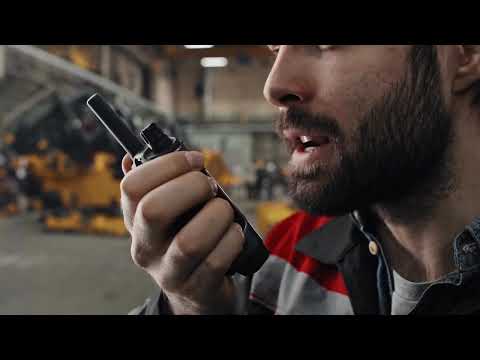 Watch: What is push to talk? · 1-minute explainer
Where the name comes from: the original push-to-talk service was Nextel's iconic "chirp" in the 1990s and 2000s. When Nextel's network shut down in 2013, the technology moved to cellular data networks — today's PTT over cellular delivers the same instant communication with nationwide range. Read the full Nextel story here.
How does push to talk work?
Modern push to talk works by sending your voice as data over 4G LTE cellular networks (or Wi-Fi) to a PTT server, which instantly relays it to every radio, phone, and dispatch console on your channel — typically in about one second, anywhere in the country.
Because the network is the carrier's, range is effectively unlimited — two radios work as well 2,000 miles apart as they do across a jobsite. Coverage is everywhere your team already has cell service, across AT&T, T-Mobile, Verizon, and US Cellular LTE networks. See the coverage map.
The benefits of push to talk for your business
PTT isn't a gadget upgrade — it changes how fast your operation moves. These are the benefits our business customers actually report:
 Watch: The benefits of PeakPTT radios · 2 minutes
Push to talk vs. company cell phones
Cell phones are fine for offices. In the field, they're slow: dial, ring, wait, voicemail, call back, repeat — and every driver looking down at a screen is a liability. A PTT call lasts about 15 seconds; the same exchange by phone averages 50+ seconds, plus the missed calls in between.
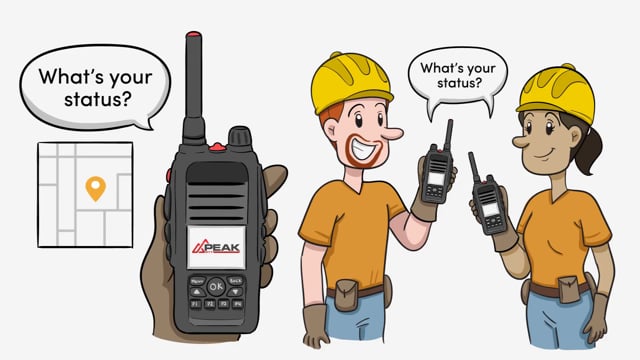 Watch: What company cell phones really cost · 2 minutes
| Company cell phones | PeakPTT radios | |
|---|---|---|
| Reach the crew | One call at a time, if they pick up | Everyone hears you in ~1 second |
| Typical exchange | 50+ seconds per call | ~15 seconds |
| Missed messages | Voicemail & unread texts | Heard live — plus recorded playback |
| Driving | Screens invite DOT violations | One button, eyes on the road |
| Durability | Glass slabs in work gloves | Rugged, IP-rated, glove-friendly |
| Monthly cost | $40–80+ per line with data | One flat rate per radio, unlimited PTT |
Already carrying phones? Add the PeakPTT app for iOS & Android and phones join the same channels as your radios.
Push to talk vs. traditional two-way radios
Traditional land mobile radio (LMR) — the classic Motorola-style UHF/VHF system — is limited by physics: your range is your repeater's range, your license is an FCC filing, and your budget carries towers, dealers, and maintenance contracts.
PTT over cellular uses networks that already exist. Coverage is nationwide on day one, there's no FCC license to file, and radios arrive pre-programmed. If you already run LMR, we bridge both worlds — a RoIP gateway puts your legacy radios and PeakPTT devices on the same channels.
 Watch: Push-to-talk from PeakPTT · 90 seconds
Want the full breakdown? We keep a detailed side-by-side here: PTT over cellular vs. two-way radios — the complete comparison.
Push to talk devices: radios, phones & dispatch
One platform, three kinds of hardware — all on the same channels:
Safety: distracted driving & GPS accountability
Eliminate distracted driving
Texting drivers are a lawsuit waiting to happen. PTT radios give drivers one physical button — no screens, no scrolling — so they can communicate instantly while staying compliant with DOT/FMCSA hands-free rules and keeping their eyes on the road.
Real-time GPS tracking, included
Every PeakPTT radio reports its position every 60 seconds to the dispatch console — live map, breadcrumb history, and SOS alerts with location. No extra devices, no per-vehicle tracking subscription. Dispatchers see the whole fleet and talk to it from the same screen.
Who uses push to talk?
Any operation where people work spread out and the clock matters. Eighteen industries run their day on PeakPTT — read how teams like yours deploy it:
How to choose a push-to-talk solution
Evaluating PTT services for your field teams? These are the questions that separate real providers from resellers:
- Carrier-certified devices. Radios should be tested and approved on U.S. carrier networks — uncertified imports get throttled or bricked.
- Tier-1 native SIMs. Real AT&T / T-Mobile / Verizon data, not gray-market MVNO resale that deprioritizes you at 5pm.
- Radios or apps — or both. Crews in gloves need hardware; office staff need apps. Pick a platform where both share channels.
- GPS & dispatch included. Position updates and a live dispatch map should be built in, not a $10/seat add-on.
- Real support. When a channel goes quiet at 6am, you need a human — ours answer 24/7 and own the problem.
- No contracts. A provider confident in its service doesn't need to lock you in for 36 months. We don't.
- Honest pricing. Flat monthly rate, published on the website. Ours is right here — $24.95/month unlimited nationwide PTT.
- Try-before-you-commit. A 45-day money-back guarantee means the risk is the provider's, not yours.
Push to talk: frequently asked questions
What does PTT stand for?
How far does push to talk work?
Do push to talk radios need an FCC license?
Does push to talk work without cell service?
Can push to talk work on a regular smartphone?
How much does push to talk service cost?
What happened to Nextel push to talk?
Are the radios ready to use out of the box?
See push to talk on your operation
Tell us your team size, coverage area, and how your crews work — we'll recommend the right radios and set you up with pre-programmed devices, ready to talk out of the box.
45-day money-back guarantee. If PeakPTT doesn't transform how your team communicates, send it back for a full refund (minus airtime).
- $24.95/month unlimited nationwide PTT
- Radios arrive pre-programmed
- No contracts · no FCC licensing
- Real humans answer 24/7